Fifteen years of central banking reveal about the harder work still ahead reaching the farmer, the entrepreneur, the shop owner, and a fund now living on its own returns.
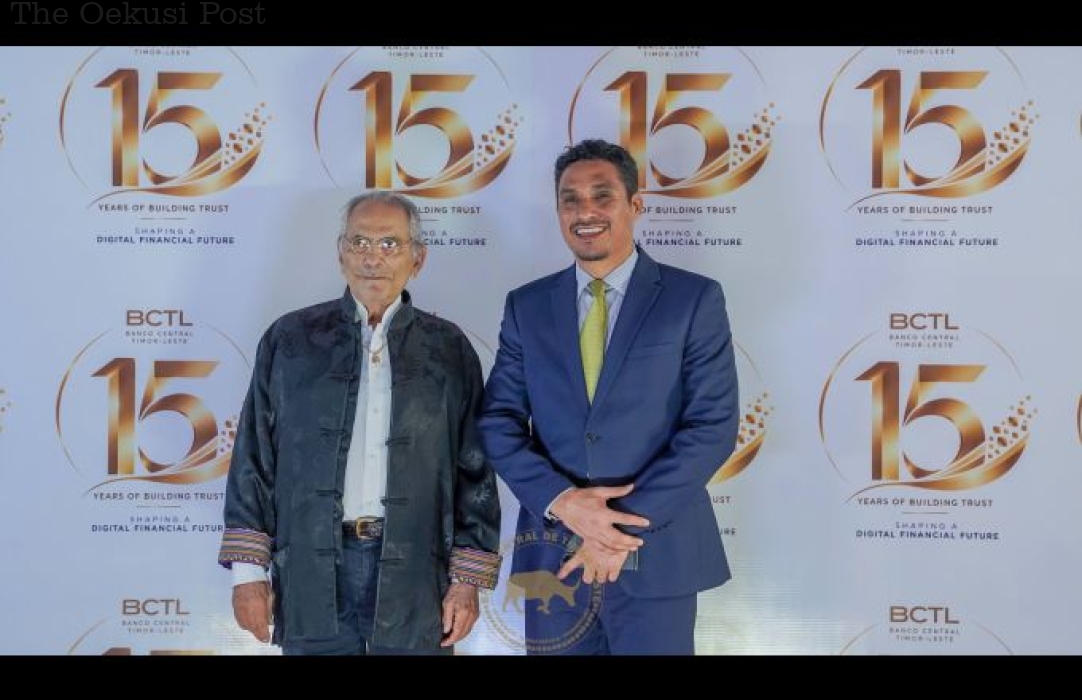
DILI (TOP) — There is a phrase Governor Helder Lopes chose to say in Tetum, not English, at Banco Central de Timor-Leste's fifteenth anniversary: Banku Iha Hau Nia Bolsu. Bank in my pocket. It names, in five words, what the country's financial development story has actually been about these past fifteen years not interest rates or reserve ratios, but the distance between a national institution in Dili and a farmer in Bobonaro, a student in Baucau, a small entrepreneur in Oe-Cusse Ambeno, a shop owner in Ermera, a public servant in the capital. The Governor named all five in a single breath. Closing that distance, more than any single policy, is the project BCTL has set for itself.
It is a project with an unusual starting condition. Timor-Leste runs a fully dollarized economy the US dollar is legal tender alongside domestic centavo coins which means the central bank does not set a policy interest rate and cannot manage an exchange rate, the two instruments most of the world associates with a monetary authority. Financial development here has therefore never been a story about clever use of policy levers. It has been a story about building things from underneath: infrastructure, law, trust, one layer at a time, in a country that in 2011 was, in the Governor's own description, "overwhelmingly a cash-based economy."
From cash to a national grid
The infrastructure part of the story is the one with the clearest before-and-after. Fifteen years ago, financial institutions in Timor-Leste barely spoke to each other; digital financial services scarcely existed. What has been built since is layered and, by regional standards, fast-moving: R-TiMOR, a real-time settlement system linking the central bank, commercial banks and the Ministry of Finance; P24, a national payment switch that let a card issued by one bank work at another's ATM; electronic tax payments; customs payments routed through the ASYCUDA platform; international card acceptance through Visa, Mastercard and UnionPay.
The newest layer, Ti-Fast, is the one meant to finally reach the people the Governor named. Built around a unified QR code standard called TUQR and an underlying architecture BCTL calls "BESIX," it is designed to let money move instantly between individuals, businesses, government twenty-four hours a day, without needing a bank branch nearby. For a country where much of the population lives outside Dili and where physical banking infrastructure has always been thin, a QR code that works the same way in Oe-Cusse Ambeno as it does in the capital is not a minor convenience. It is closer to the actual definition of financial inclusion.
BCTL is not treating domestic coverage as the finish line. The Governor described the future explicitly as cross-border: "not merely national QR payments" but "cross-border QR connectivity," not just domestic instant transfers but eventual links to regional instant-payment networks, and stated as settled direction rather than a wish "digital financial integration with ASEAN." No date accompanied that ambition. But naming it as policy, at a moment when Timor-Leste is moving through the early stages of full ASEAN membership, ties the country's payments story to a regional one that is still being written elsewhere.
The paradox no fintech layer can solve alone
Payments infrastructure is the visible half of financial development. The other half whether ordinary businesses can actually borrow money to grow is where the country's progress looks far less settled, and where BCTL's own language turned notably self-critical.
"For too long," the Governor said, "Timor-Leste has faced a paradox: we have substantial financial resources, yet too much domestic liquidity remains disconnected from productive investment." That is a central bank describing its own financial system as sitting on cash it isn't putting to work. The businesses paying the price, by the Governor's own account, are the ones a diversifying economy most needs small and medium enterprises, agricultural producers, tourism operators locked out of affordable financing. BCTL's most recent published figure puts the average lending rate at roughly 10.23 percent, as of June 2026. For a small business without land or a building to pledge as collateral, that is often less a price than a wall.
The remedy BCTL is leaning on is legal rather than monetary: a newly established framework allowing movable property equipment, inventory, receivables, anything short of fixed real estate to be used as loan collateral, alongside planned upgrades to credit information systems and to insolvency and creditor-rights law. It is an unglamorous fix, the kind of institutional plumbing that rarely makes headlines, but it targets the actual mechanism by which a farmer or a small trader is currently excluded from the formal credit system: nothing a bank recognizes as security. The Governor set the ambition in structural terms moving the financial system "from a financial system that primarily holds liquidity toward one that increasingly intermediates liquidity into productive domestic investment" a shift from a system that stores money to one that circulates it. Fifteen years in, BCTL's own framing makes clear that shift has only begun.
A fund learning to live without the resource that built it
The most consequential financial development story in Timor-Leste right now, though, may not be about banking at all. It is about $18 billion sitting in the Petroleum Fund, and the fact that the resource which built that fund is running out.
The numbers tell the story on their own. In 2025, petroleum revenue the income the Fund exists to convert into long-term national wealth came to approximately $36 million. Investment income that same year reached roughly $1.77 billion, meaning essentially all of the Fund's growth came from the performance of its own portfolio, not from new oil and gas. By the end of July 2026, the Fund stood at approximately $18.43 billion, split across global fixed income (about $12.49 billion), global equities (about $5.38 billion) and private debt (about $558 million). Cumulative investment income since the Fund's founding roughly $12.03 billion now accounts for the majority of everything it has ever earned.
The Governor's term for this moment was direct: a "post-petroleum-revenue era." What sustains the Fund going forward, in that telling, is no longer the ground but the market "investment performance, disciplined risk management, and sustainable withdrawals." The Governor framed it as a question of intergenerational fairness rather than pure finance: "Every dollar in the Petroleum Fund represents a choice between consumption today and opportunity tomorrow."
What the anniversary speech did not supply is the number that would let anyone outside government actually judge how that choice is being made how much the state plans to withdraw from the Fund in the coming budget cycles, set against the roughly $1.7–1.8 billion a year the Fund has recently been generating in investment income. That withdrawal decision belongs to the Government and Parliament, not the central bank, and BCTL's silence on it reflects a real division of institutional authority rather than an oversight. But it leaves the fund's actual trajectory how long $18 billion can support a national budget once petroleum income has effectively ended as an open question rather than a stated fact.
What "financial development" means from Dili
Strip away the ceremony, and the anniversary speech reads as a fairly unsentimental self-assessment: a payments system that has genuinely transformed how money moves in Timor-Leste, a credit market still failing the small businesses the economy needs, a currency question being studied but not decided, and a sovereign fund quietly shifting the ground it stands on from oil to markets.
The Governor's closing image was of BCTL as an institution whose real product is trust "the architecture of economic trust," built through fifteen years of laws, systems and reserves, but only truly sufficient once it reaches "families, businesses and future generations" who can "plan their lives with greater confidence." Whether that trust has actually reached the farmer in Bobonaro or the entrepreneur in Oe-Cusse Ambeno the Governor named is not something an anniversary speech can settle. It is something the next fifteen years of lending rates, QR transactions and Fund withdrawals will have to answer instead.