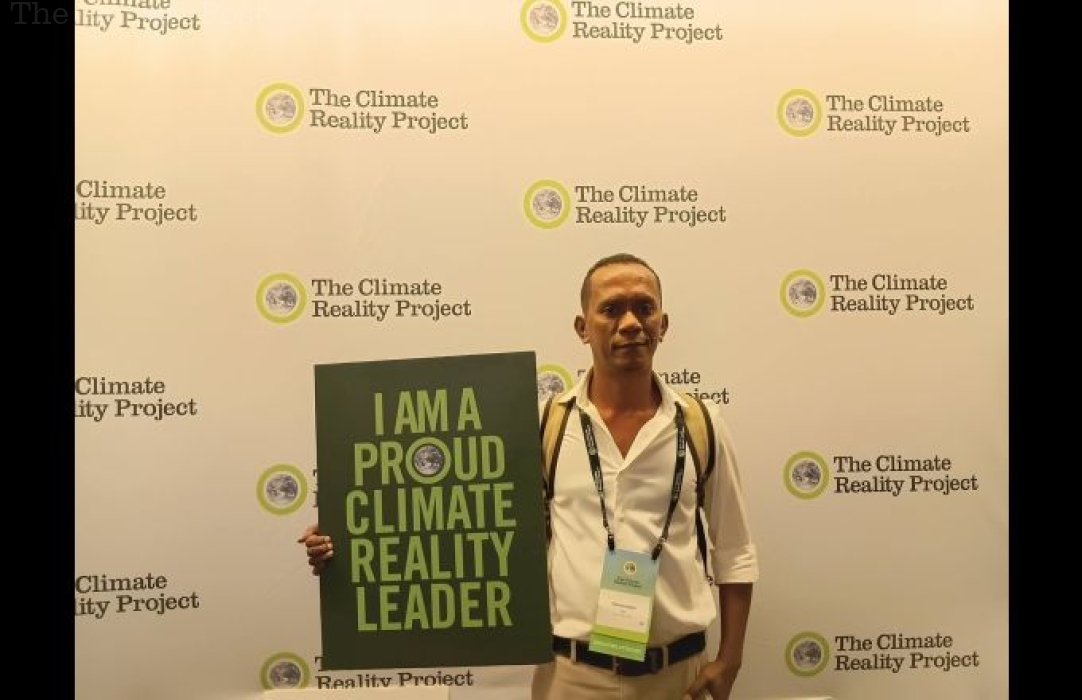
SINGAPORE (TOP) — I sat among nearly 800 participants composed of activists, finance professionals, scientists, and students, half of them under the age of 30 who traveled from across the Southeast Asian region including Timor-Leste to attend a two-day Royalty Corps Leadership training in Singapore, Singapore 8-9 September 2026.
This big and important two-day event, I was the only one from Timor-Leste. Online media The Oekusi Post was among the media present at the meeting, part of a small group of regional press representatives and small countries monitoring how the warning messages from the training were received by the communities most vulnerable to the adverse impacts described.
In the upbeat tone of an event designed to equip a new generation of environmental advocates, the overriding message that echoed through the room was a warning: the danger is growing too fast.
Former US Vice President Al Gore, the keynote speaker at the training, delivered a message that demanded serious attention rather than offering comfort.
He says the world treats his sky like an open sewer.
According to him, the consequences of this habit will arrive faster than governments in the region are prepared to act.
Gore's warning is full of data designed to make an invisible threat tangible and conceivable. The world adds approximately 175 million tons of greenhouse gases to the atmosphere every day, an amount whose cumulative effect on heat trapping is equivalent to the daily detonation of 800,000 atomic bombs the size of the Hiroshima bomb. This is a stark statistical picture, with numbers rising steadily year by year as Gore has presented the data at various forums, from Davos to Nairobi.
The founder of the Climate Reality Project noted that historical records underscore the urgent situation. An 11-year period from 2015 to 2025 was the warmest on record, and this year is expected to set a new high temperature a record that will likely be surpassed again in 2027 thanks to the phenomenon Gore calls “Super El Niño.”
Independent forecasters also issued these warnings that, projections by the UK Met Office indicate that once the current El Niño fully develops, temperatures in the equatorial Pacific could rise above levels seen in previous episodes, a scenario described by a senior Met Office forecast as previously forecast in history meteorological.
Again the World Meteorological Organization (WMO) projects that the combined impact of extreme heat, drought, and disruption to the growing season could push the number of people facing hunger worldwide to skyrocket past 270 million by the end of 2027.
For a region defined by river deltas, monsoon-dependent agriculture, and coastal cities, the most pressing threat outlined by Gore is not heat in the abstract sense, but the increasing behavior of water.
The former US president explained to an audience in Singapore that warmer oceans intensify the water cycle; the same heat that causes longer and more severe droughts also loads the atmosphere with moisture, resulting in heavier and more destructive rainfall.
The already vulnerable Southeast Asian region to flooding and drought stresses lies directly in the path of opposing extremes.
Another, slower-moving but equally consequential danger lurks in the glaciers of the Himalayas, the source of water for the river systems that sustain much of Asia.
Gore warned that up to 80 percent of that ice could disappear by the end of the century without a drastic change in policy a prediction with repercussions extending far beyond the mountain itself, affecting water security for hundreds of millions of people downstream. These threats are more than just projections.
The training organizer highlighted the recent energy crisis that has caused prices to rise and burdened businesses and households in a region that is expected to contribute to global energy demand growth over the next decade.

Rising sea levels, more severe storms, and warmer temperatures are exacerbating these pressures, leading to an estimated need for an annual investment of US$210 billion in climate-resilient infrastructure by 2030, a number that exceeds commitments from financing, leaving a gap which organizers say can only be funded through regional innovation, and sustained public pressure regional funding.
President and CEO of the Climate Reality Project Phyllis Cuttino describes, the next decade in Asia is a pivotal period for the trajectory of the global climate crisis.
Emissions continue to rise, he warns, despite waning political ambition in regions that once pioneered climate policy.
Gore made his most scathing critique of what he saw as the main obstacle to faster action than the political influence of the fossil fuel industry.
He rejects the “climate realism” narrative, the argument that energy transitions must accommodate continued reliance on oil, gas, and coal as a repackaged denial rather than an objective assessment of existing constraints.
In his view, the main obstacle is not the lack of viable alternatives, but the industry’s steadfast power to protect its dwindling share of the energy market, while political leaders including those in his own country continue to operate under its control.
He delivered this critique with a sense of urgency rather than resignation. Gore described the current situation as “a race between increasing threats and the availability of solutions that increases a race the world has not yet won, as it risks crossing the climate dangerous tipping point unless the pace of change accelerates significantly”.
In addition to these warnings, the training provided to participants including our editorial team offered tools to turn concern into concrete action.
Gore introduced Climate TRACE, a satellite and data-driven platform supported by his organization. It tracks greenhouse gas emissions by source and location with high precision, allowing activists and journalists to focus their coverage and policy advocacy on the specific facilities and industries driving the crisis, rather than on abstract issues.
The training took place in Singapore because, for strategic reasons as a financial hub, the city is well positioned to channel capital to support the clean energy transition across the region.
According to the organizers, Singapore was also the ideal place for a network of leaders and journalists to drive this warning home, particularly as the window for the region to address these threats was, in Gore’s own assessment, closing fast.
The Oekusi Post leaves Singapore with this warning, as well as a clearer understanding of the direct impact on coastal areas of small countries and communities in border regions that are the main focus of our coverage.