


AMBENO (TOP) - Air quality in Dili and across the national territory has been poor for almost a week because of somoke from land and forest fires (queimada florestal) in Indonesia’s West Papua region.
Indonesia continues to burn. Forests and land are being consumed by fire, and smoke is choking people’s lives. People have lost access to clean air, while animals have lost their homes. Now the effects of this disaster have reached Timor-Leste too.
The National Directorate of Meteorology and Geophysics (DNMG), under the Ministry of Transport and Communications (MTC), confirmed that from 6 to 12 October 2026, the automatic stations at Presidente Nicolau Lobato International Airport in Comoro and at the Ministry of Transport and Communications in Caicoli recorded poor air quality. According to DNMG, winds from Australia carried smoke containing polluting particles to the island of Timor, and local land burning may also be contributing.
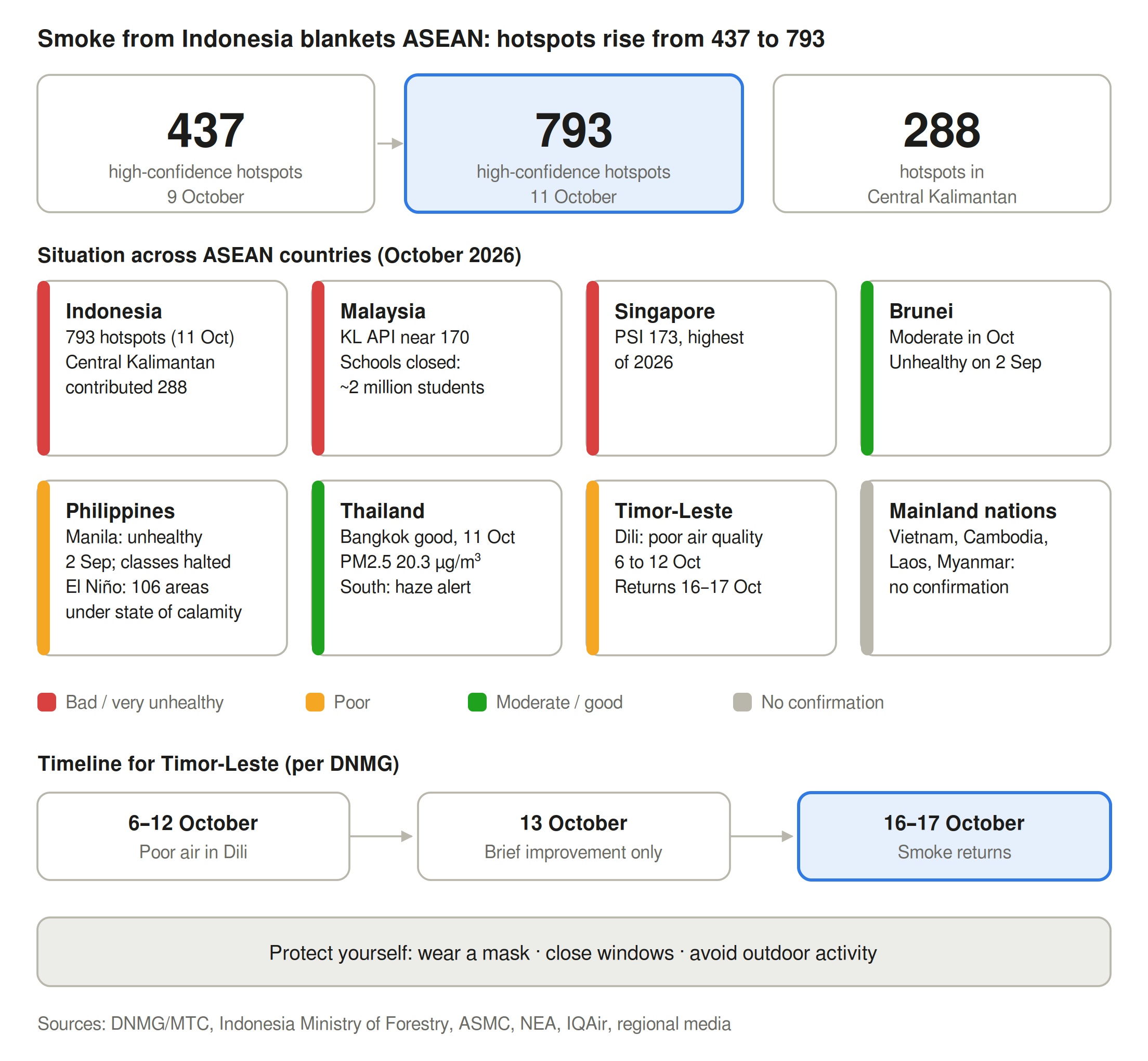
In Indonesia itself, the number of fires is rising. On 11 October 2026, the Ministry of Forestry reported 793 high-confidence hotspots, based on monitoring from the previous day. This is up from the 437 hotspots recorded on 9 October.
Central Kalimantan is the area of greatest concern, contributing 288 of these hotspots. Although the hotspot count may not reflect the actual number of fires, the data highlights an ongoing threat.
The situation in ASEAN member states
Timor-Leste is not alone. Smoke from Indonesia is affecting the entire region.
Malaysia. The government closed schools in the capital and several states, affecting nearly two million students, as the Air Pollutant Index (API) in Kuala Lumpur reached about 170. The state of Johor closed all schools for two days. Prime Minister Anwar Ibrahim said he had spoken with Indonesian President Prabowo Subianto, who agreed to take “the necessary steps,” and that he had asked the foreign minister to arrange an urgent meeting of ASEAN environment ministers.
Singapore. The 24-hour Pollutant Standards Index (PSI) in the central region reached 173, the highest reading of 2026. IQAir has classified the air in Singapore as “very unhealthy.” The National Environment Agency (NEA) warned that air quality could reach that level if winds continue to carry smoke from Kalimantan and Sumatra.
Brunei. On 2 September, air in the capital, Bandar Seri Begawan, reached “unhealthy” levels, with PM2.5 about 13 times higher than the World Health Organization’s safety limit. However, recent reports show that air quality in Brunei has worsened slightly but remains moderate nationwide.
Philippines. On 2 September, stations in Metro Manila recorded “unhealthy” PM2.5 levels, and authorities suspended classes. At the same time, El Niño has placed 106 areas under a state of calamity, affecting more than 300,000 people.
Response from Indonesia’s government and ASEAN
On 8 October, Malaysian Prime Minister Anwar Ibrahim contacted President Prabowo Subianto directly by phone. Anwar said Prabowo agreed to take the necessary steps but gave no details. Malaysia’s foreign and environment ministers have also been in contact with their Indonesian counterparts.
Indonesia’s embassy in Malaysia expressed “deep concern” to the Malaysian public. Jakarta has also deployed 15 Casa aircraft for weather modification and cloud-seeding operations in West Kalimantan, Central Kalimantan and South Sumatra.
Malaysia has itself stepped up cloud seeding almost daily through the Royal Malaysian Air Force (RMAF) and other agencies. Anwar acknowledged that the situation remains worrying. He asked Foreign Minister Mohamad Hasan to contact the ASEAN Secretariat to arrange an urgent meeting of ASEAN environment ministers. At the same time, Anwar said Malaysia is ready to cooperate with Indonesia.
Cloud seeding has also been carried out in Singapore, Brunei and on Indonesia’s side, and experts say a strong El Niño is making this pollution the worst in several years.
Mainland Countries: Thailand and neighbors
Thailand. The Pollution Control Department (PCD) has warned southern provinces, especially the Lower South and border areas, that smoke from Sumatra could raise PM2.5 risks. Yala and Narathiwat provinces have already recorded PM2.5 above the national standard. In Bangkok, however, air quality on 11 October remained good, with average PM2.5 of 20.3 µg/m³, below the standard limit of 37.5 µg/m³.
Vietnam, Cambodia, Laos and Myanmar. Experts at the Copernicus Atmosphere Monitoring Service (CAMS) have warned that smoke could reach Cambodia and Vietnam if the fires keep growing. However, in the reports reviewed up to 12 October, there is no public confirmation that these countries have suffered serious pollution from this episode. They have their own haze season in March–April, when agricultural fires and land and forest fires cover much of the Mekong sub-region.
At the regional level, ASEAN already has a sub-regional ministerial committee on haze for the Mekong. The ASEAN Conference of the Parties on Transboundary Haze Pollution (COP-21) is expected in October 2026 in Da Nang, Vietnam.
Forecast: brief improvement, but smoke will return
DNMG says that from 13 October 2026, air quality will improve again. However, the improvement will be temporary, lasting only a few days, because land burning continues in the Papua area.
DNMG also warns that on 16–17 October 2026, winds will bring smoke from the Indonesian side of Timor island again. This period coincides with the season when farmers in Timor-Leste burn their fields, so air quality will remain poor. DNMG will keep monitoring air quality at its stations, together with weather and wind conditions.
At the regional level, the ASEAN Specialised Meteorological Centre (ASMC) warns that El Niño conditions and below-normal rainfall will keep hotspots and smoke high. Rain in late October could help ease the situation.
Guidance for the public
To protect their health, DNMG urges the public to take care and wear masks to avoid illness caused by air pollution. Key guidance:
- Wear masks, especially children, the elderly and vulnerable people.
- Avoid physical activity outdoors during periods of heavy smoke.
- Close windows when there is heavy dust or smoke.
- Avoid burning rubbish near children, the elderly and vulnerable people.
- Use an appropriate filter mask when outdoors.
- Seek medical help if you have difficulty breathing.
Land and forest fires produce smoke and polluting particles that can degrade air quality and harm human health. The most vulnerable groups are children, the elderly and people with respiratory illness.
Smoke from land and forest fires knows no borders. When fires break out in Indonesia, the smoke can affect the air people breathe from Dili to Kuala Lumpur and Singapore. DNMG stresses: protect our health and our families, avoid pollution and protect air quality.