


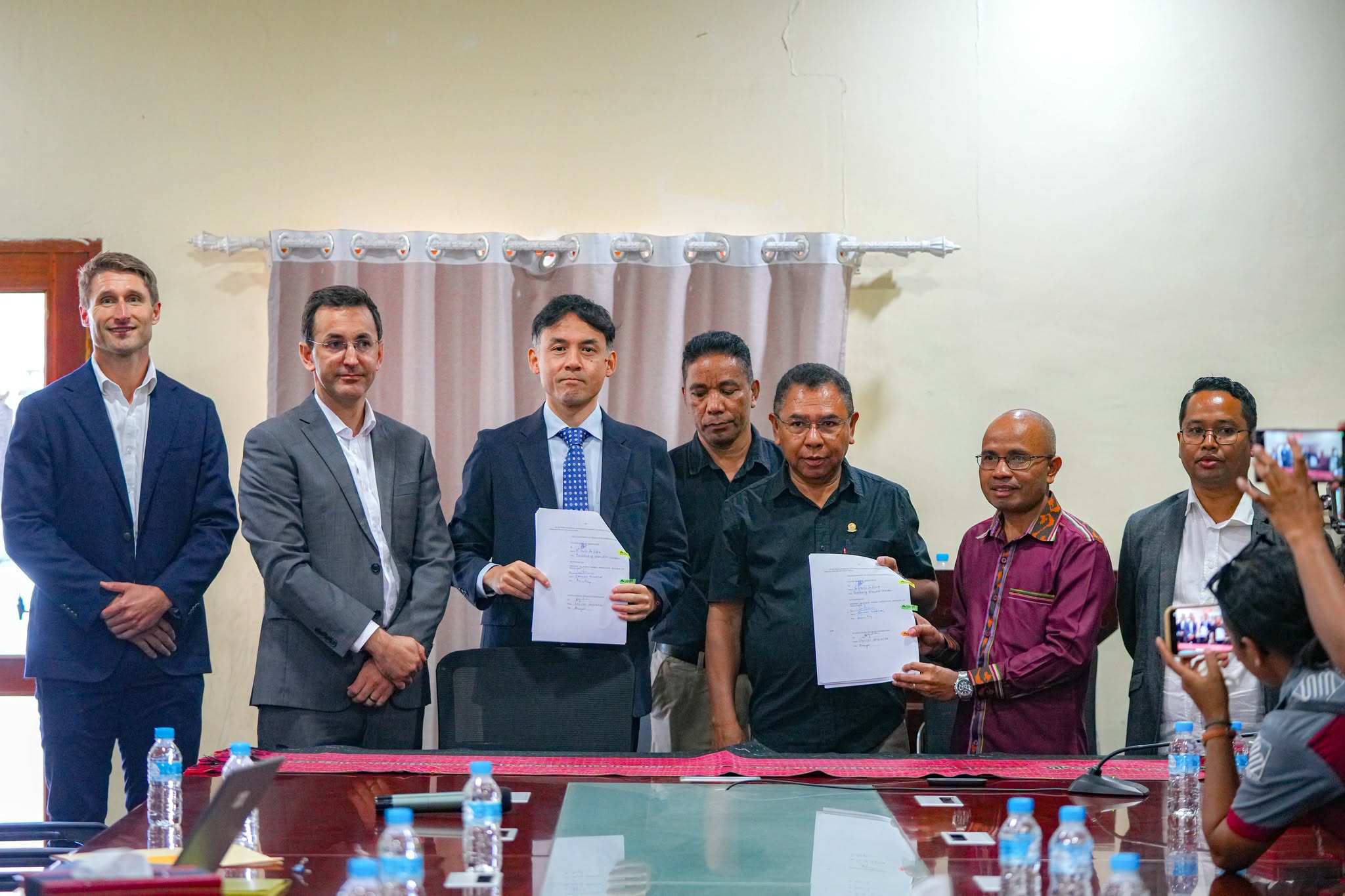
DILI (TOP) – Electricidade de Timor-Leste (EDTL) and the International Finance Corporation (IFC) have signed a technical assistance agreement for wind farms in Oeleu (Bobonaro) and Larigutu (Viqueque), aiming to reduce dependence on electricity subsidies.
Oeleu, in Bobonaro Municipality, and Larigutu, in Viqueque Municipality, lie far apart, but wind has become a new source of hope for Timor-Leste at both. In recent years, technical teams have installed 100-metre measurement towers at both sites to determine precisely how strongly and how fast the wind blows. Today, the first step of the national wind power project was formalised when the Government of Timor-Leste, through the Ministry of Public Works (MOP) and EDTL E.P., signed a technical assistance agreement with the IFC, the World Bank’s private-sector arm.
An agreement for preparation, not construction
It is important to understand that this agreement does not yet mean turbines will be built. The document establishes the technical assistance instrument the IFC will provide to EDTL to prepare the documents and technical processes needed to develop projects at the two sites. In the future, the projects will be developed through private-sector investment.
The World Bank’s representative in Timor-Leste, David Freedman, said the agreement will establish a mechanism to help EDTL and the Government achieve the goals and objectives of the Medium-Term Plan, including targets for 2027 and 2030. The IFC technical team will work with EDTL on in-depth studies of the potential for developing projects in Larigutu and Oeleu.
A long-standing plan enters a new phase
Minister of Public Works Samuel Marçal said that using wind energy in Oeleu and Larigutu is part of the Government’s strategic plan, which has been in planning for many years and is now only beginning to enter the implementation phase. He described the signing of the agreement as an important step for Timor-Leste’s energy future, particularly in reducing dependence on costly energy sources that rely on international markets.
Minister Marçal linked the decision to global realities. “We all know that after the war in the Middle East, oil prices on the international market rose and affected many countries,” he said. He argued that Timor-Leste, though remote and not yet producing much domestically, is not without resources. He stressed that the country has considerable wealth and needs to develop these resources to help sustain the State in the future.
For the Minister, electricity is basic infrastructure that is vital to national development, because a stable supply allows other sectors to function well. For this reason, the Government is giving maximum attention to renewable energy, including wind and solar, to lower the cost of producing electricity and, over the long term, reduce dependence on Government subsidies.
Subsidy money for rural areas
The Government’s central argument is simple: money spent on electricity subsidies can be used for other things. “When we start using wind energy and solar energy, we can reduce the budget the Government spends on electricity,” Minister Marçal said. He said the money normally used for subsidies could be redirected to other priorities for the people, especially in rural areas, villages, sucos and municipalities.
MOP hopes the projects can advance quickly and enter the implementation phase in 2027 or 2028. The final goal is for EDTL to be able to increase its capacity to stand on its own with financial sustainability and reduce dependence on Government subsidies by 2030–2031.
From studies to tender: the timeline
EDTL E.P. President Paul Da Silva explained that feasibility studies for the two projects began last year and will continue. Through the new agreement, the IFC will provide technical assistance to EDTL, particularly in preparing tender documents.
“Today is an important step in the process of preparing the tender for the wind power project,” Da Silva said. He said the process starts today and is expected to be completed by mid-next year so that the tender can be launched. EDTL expects to be able to sign a Power Purchase Agreement (PPA) for the project by the end of 2027.
On the budget, Da Silva admitted there is not yet a final figure, as the preparation process and technical estimates are still under way.
The Laleia model: private sector leads investment
The wind project will use the Independent Power Producer (IPP) model, the same model the Government has already used for the solar photovoltaic project in Laleia, Manatuto Municipality. Under this model, investment comes from the private sector, and the IFC supports EDTL in the preparation process.
Freedman explained that, with IFC support, EDTL will prepare project-specific documents so that, once everything is ready, the tender can be launched through an open and competitive process. “With this process, we can mobilise investors to develop projects like the solar project model that was just launched in Laleia in July this year,” he said.
100-metre towers and wind data
An important part of the preparation is data measurement. Freedman said technical teams have installed 100-metre towers at the two sites to measure wind speed and potential. Measurement will continue. This data will form the basis for the feasibility studies and for investors’ decisions.
Partner commitment
In his remarks, Freedman stressed that the IFC and the World Bank are proud to work with EDTL and MOP to develop the renewable energy sector in Timor-Leste. He thanked EDTL’s leadership, the technical team and the Prime Minister for their vision and commitment in bringing the process to this important step. Minister Marçal also thanked the EDTL technical team, the IFC and the World Bank for their efforts during the preparation process.
The IFC and the World Bank reaffirmed their commitment to continue providing technical support to the Government and EDTL to accelerate preparation of the wind project and help Timor-Leste achieve its sustainable energy development goals.
Timeline summary
- 6 October 2026: EDTL–IFC technical assistance agreement signed
- Mid-2027: tender preparation expected to be completed
- End of 2027: Power Purchase Agreement expected to be signed
- 2027–2028: project expected to enter implementation phase
- 2030–2031: EDTL’s target for financial sustainability