A dollarized economy with no policy rate, a financial system flush with liquidity but starved of lending, a payment network racing to catch up with ASEAN, and a sovereign wealth fund now doing the work oil once did Banco Central de Timor-Leste's 15th anniversary speech was less a celebration than a status report on four unfinished projects.
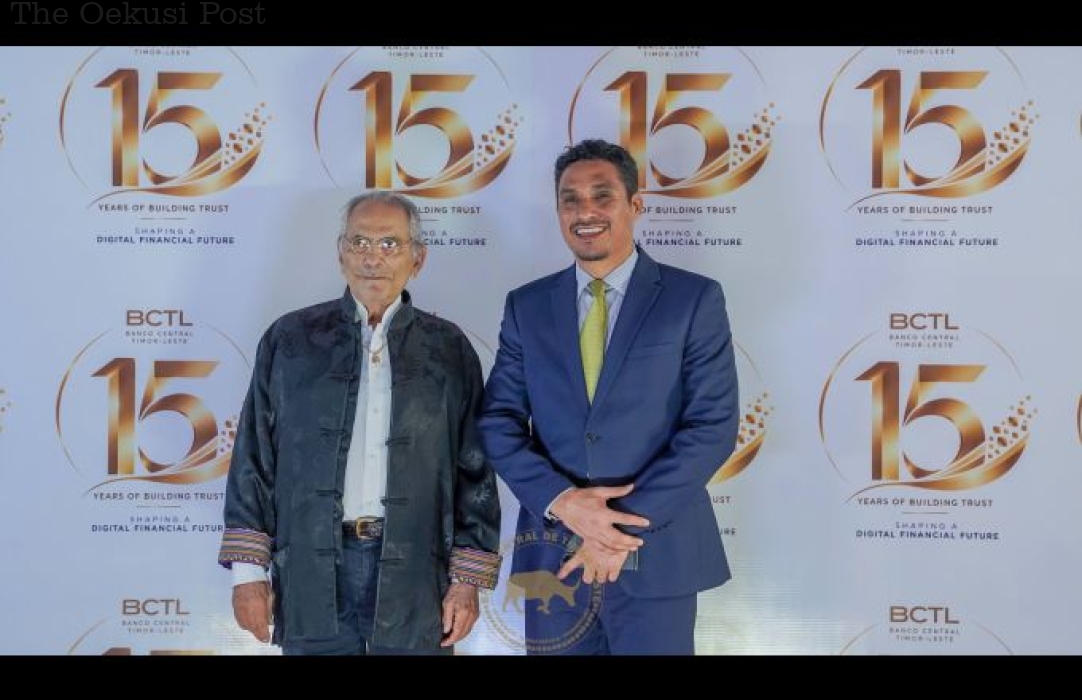
DILI (TOP) — When Banco Central de Timor-Leste (BCTL) was established on 13 September 2011, the institution's task looked, on paper, relatively narrow: stand up a monetary authority for a young nation still rebuilding basic economic infrastructure. Fifteen years later, at an anniversary ceremony attended by the President of the Republic, the President of the National Parliament, the Prime Minister, the Vice Prime Minister, members of Parliament and Government, and representatives of ASEAN and international financial institutions, the Governor's address made clear that the task has not gotten narrower. It has multiplied.
"We began as a young institution operating in a young nation," the Governor said. "Today, we are increasingly connected to regional and international financial systems and are preparing ourselves for the opportunities and responsibilities of Timor-Leste's deeper integration into ASEAN."
The speech was organized around four mandates the Governor described as "deeply interconnected": price stability, financial stability, the national payment system, and the prudent management of reserves including operational management of the Petroleum Fund. Taken individually, each is a familiar central-banking function.
Taken together, and set against Timor-Leste's specific circumstances full dollarization, a shrinking flow of petroleum revenue, and a private sector still struggling to borrow they describe an institution attempting something unusual: building the tools of monetary policy in a country that, for now, has given up the instruments that would let it use them.
A central bank without a policy rate
The starting point for everything else in the speech is a structural fact about Timor-Leste's economy: it is fully dollarized. The United States dollar is legal tender, alongside domestically minted centavo coins, and BCTL does not currently set a domestic policy interest rate or manage an exchange rate the two levers most central banks use to influence inflation and economic activity.
"This does not make price stability less important," the Governor told the audience. "It makes our responsibility more complex."
Inflation in Timor-Leste, the Governor said, is shaped largely by forces outside the country's control: international commodity prices, global food and energy markets, movements in the US dollar itself, domestic supply conditions, fiscal policy, and the economy's heavy reliance on imports.
Without a policy rate to lean on, BCTL has spent the past fifteen years building what the Governor called capacity in "macroeconomic surveillance, monetary and financial statistics, balance-of-payments analysis, inflation monitoring, and economic research and policy advice." In practice, this has meant becoming a data and analysis institution as much as a regulatory one producing independent economic analysis for the Government, the National Parliament, the financial sector, investors and the public, in place of the interest-rate signals a conventional central bank would send.
The Governor acknowledged that this arrangement carries real risk. Timor-Leste's economy, the speech noted, "remains vulnerable to imported food and energy shocks, geopolitical tensions, exchange-rate developments, climate-related disruptions and global financial volatility" all channels through which inflation can arrive without the central bank having any direct tool to counter it.
The bank's stated response is to become "increasingly forward-looking rather than reactive," leaning more heavily on the fiscal and financial-policy tools that, in a dollarized economy, have to substitute for monetary policy. "Fiscal policy, financial policy, structural reforms and prudent liquidity management," the Governor said, "together carry much of the responsibility normally shared with monetary policy."
The sovereignty question, handled carefully
It was in this context that the Governor made the speech's most closely watched statement: that BCTL will continue "rigorous technical research into the economic, institutional, financial and operational conditions that would be required should Timor-Leste, at some future point, consider greater monetary sovereignty."
The framing was deliberately cautious. "This work must never be driven by symbolism or a predetermined timetable," the Governor said. "
A national currency cannot simply be printed into credibility, credibility must first be built." That credibility, the speech argued, depends on a long list of preconditions sustained price stability, adequate reserves, fiscal sustainability, a strong banking system, deep public confidence, reliable payment infrastructure, sound institutions, and the technical capacity to run credible monetary policy that Timor-Leste has not yet fully established. "Our approach, therefore, will be based on readiness, evidence and national interest," the Governor said, offering no timeline and no indication of which currency arrangement, if any, is under active consideration.
Plenty of liquidity, not enough lending
If the price-stability section of the speech was about tools BCTL doesn't have, the financial-stability section was about a resource the country has in abundance but isn't using well: liquidity.
BCTL now regulates and supervises commercial banks, insurance institutions, other deposit-taking institutions, money transfer operators, money changers, fintech companies and other financial intermediaries a supervisory footprint that has grown considerably from the "small, concentrated" sector the Governor said existed at the bank's founding. Licensing requirements, prudential supervision, risk monitoring, anti-money-laundering and countering-the-financing-of-terrorism (AML/CFT) frameworks, financial reporting and institutional governance have all been built up over the intervening years.
By the Governor's account, the result is a financial system that is "sound and stable," with credit to the private sector expanding, insurance services growing, and new digital financial providers broadening the market. But the speech was candid about a persistent gap between the size of the financial system and what it delivers to the wider economy. "For too long, Timor-Leste has faced a paradox," the Governor said.
"We have substantial financial resources, yet too much domestic liquidity remains disconnected from productive investment." Small and medium businesses, agricultural producers, and tourism operators, in particular, were singled out as continuing to face difficulty accessing affordable finance a difficulty reflected in the cost of borrowing itself. BCTL's latest published figure puts the average lending interest rate at approximately 10.23 percent as of June 2026.
The bank's response leans on a piece of recent legal infrastructure: a newly established framework for movable collateral, which would allow businesses without traditional fixed assets land, buildings to use other property as security for loans.
Paired with planned improvements to credit information infrastructure and to insolvency and creditor-rights frameworks, the Governor said, this is intended to "reduce information asymmetry, improve collateralization and expand financing opportunities" for businesses currently locked out of affordable credit. The explicit goal for the next fifteen years, the Governor said, is to move the financial system "from a financial system that primarily holds liquidity toward one that increasingly intermediates liquidity into productive domestic investment" a shift from safekeeping to intermediation.
From cash to QR codes, and a plan to go regional
The most visible of BCTL's four mandates, in the Governor's own description, is the national payment system and the speech used it to tell the anniversary's most concrete before-and-after story. Fifteen years ago, Timor-Leste was "overwhelmingly a cash-based economy," with limited interoperability between financial institutions and digital financial services still in their infancy.
Since then, BCTL has built a layered payment infrastructure. R-TiMOR, combining real-time gross settlement with automated clearing, connects the central bank, commercial banks and the Ministry of Finance. P24, the national payment switch introduced afterward, enabled interoperability across banks and financial service providers letting customers use cards across connected ATMs and point-of-sale terminals, and move money between banks and electronic wallets. The system has since been extended into government functions, with electronic tax payments integrated and customs payments connected through the ASYCUDA platform and the National Single Window, alongside expanded international card connectivity through Visa, Mastercard and UnionPay.
The newest addition is Ti-Fast Timor Fast Payments which incorporates a unified QR standard, TUQR, and what the Governor described as the "BESIX" digital-payment architecture, designed to enable real-time, 24-hour payments among individuals, businesses and government. The Governor summarized the ambition behind all of this in Tetum: "Banku Iha Hau Nia Bolsu"-Bank in my Pocketdescribing a goal of drawing "a farmer in Bobonaro, a student in Baucau, a small entrepreneur in Oe-Cusse Ambeno, a shop owner in Ermera and a public servant in Dili" into the same secure national digital-payment ecosystem, regardless of where in the country they live.
The speech's most forward-leaning language, though, was reserved for what comes after domestic coverage. "Our future is therefore not merely national QR payments," the Governor said. "It is cross-border QR connectivity. Not merely domestic instant transfers but eventual connectivity with regional instant-payment networks. Not simply financial inclusion but digital financial integration with ASEAN." No date was given for when that regional connectivity might arrive, but the direction tying Timor-Leste's domestic payment rails into ASEAN's broader instant-payment networks was stated as settled policy rather than aspiration.
The $18 billion at the center of it all
The speech's fourth pillar reserve management, and specifically the operational management of the Petroleum Fund carried the anniversary's most consequential numbers, and arguably its central argument: that Timor-Leste has now entered what the Governor called a "post-petroleum-revenue era."
Under the country's institutional framework, the Government sets the Fund's overall investment strategy, while BCTL is responsible for its day-to-day operational management, working alongside international investment managers, custodians and advisers.
At the end of 2025, the Fund stood at approximately US$18.61 billion. That year, petroleum revenues the resource the Fund exists to convert into financial wealth came to only about US$36 million, a small fraction of what the Fund has historically depended on. Investment income, by contrast, reached approximately US$1.77 billion over the same period, meaning the Fund's growth in 2025 came almost entirely from asset returns rather than new oil and gas revenue.
By 31 July 2026, BCTL reported, the Fund stood at approximately US$18.43 billion, made up of roughly US$12.49 billion in global fixed income, US$5.38 billion in global equities, and US$558 million in private debt. Cumulative investment income since the Fund's inception has reached approximately US$12.03 billion a figure that now represents the majority of everything the Fund has ever earned.
The Governor was explicit about what this shift means going forward: the Fund's long-term sustainability will depend on "investment performance, disciplined risk management, and sustainable withdrawals," rather than on new petroleum income the country can no longer count on. "This is therefore not merely an investment issue," the Governor said. "It is an issue of intergenerational equity.
Every dollar in the Petroleum Fund represents a choice between consumption today and opportunity tomorrow." BCTL's own mandate, the Governor added, is not to chase maximum returns but "to achieve appropriate long-term risk-adjusted returns while preserving the security, liquidity and integrity of national assets."
Separately from the Petroleum Fund, the Governor said BCTL will keep strengthening management of its own official reserves the liquidity and reserve-adequacy buffers the central bank holds in its own right describing them as "instruments of national resilience and, potentially, foundations of future monetary sovereignty." That phrase draws a direct line between the reserves conversation and the earlier, more cautious remarks about researching monetary independence: reserves, in this framing, are both a present-day stability tool and a precondition for any future currency arrangement.
Notably absent from the speech was any figure for how much the Government plans to withdraw from the Fund in the coming budget cycles, or how that compares to the roughly $1.7–1.8 billion in annual investment income the Fund has been generating. BCTL's mandate covers how the money is managed, not how much of it is spent a decision that sits with the Government and Parliament and the speech did not venture into that territory.
Four mandates, one argument about trust
The Governor's closing framing tied the four pillars together explicitly: "Price stability protects purchasing power; Financial stability protects savings and confidence; Payment systems connect households, businesses and Government; and Reserve management protects national financial wealth and resilience." Together, the Governor argued, they form "the architecture of economic trust, and trust is the true currency of a central bank." Laws, buildings, technology and assets, the speech insisted, are not enough on their own "without public trust, none of these is sufficient."
Much of the speech's final section was addressed directly to BCTL's own staff, past and present, credited with building that trust over fifteen years. The Governor invoked the acronym TIMOR Transparency, Integrity, Mobilization, Obligation, Responsibility as a statement of institutional values, and argued that central-bank independence "is not a privilege it is a responsibility," carrying with it an obligation to the highest standards of integrity, competence, transparency and accountability.
The Governor closed by reaffirming four commitments on behalf of BCTL's Board of Directors: to protect price stability; to safeguard financial stability; to build a secure, inclusive and internationally connected national payment system; and to manage the financial assets entrusted to the bank "with prudence, professionalism and integrity" thanking the President of the Republic, the National Parliament, the Government, financial institutions, ASEAN and international central-bank partners, and investment partners including Franklin Templeton, before turning to address the public directly.
"This is your Central Bank," the Governor said. "The assets we safeguard belong ultimately to the nation. The financial system we supervise exists to serve the economy. The payment infrastructure we build exists to connect our people. And the stability we protect exists so that families, businesses and future generations can plan their lives with greater confidence."
What the speech leaves open
For all its detail, the anniversary address was, by design, a statement of direction rather than a policy announcement. It confirmed that BCTL is actively researching options for Timor-Leste's long-term monetary future without committing to any of them. It described a financial system with liquidity to spare but did not set targets for lowering the roughly 10 percent lending rates businesses currently face. It laid out an ambitious vision for regional payment connectivity without a timeline. And it framed the Petroleum Fund's transition into a "post-petroleum-revenue era" as a shared challenge for the bank and the state, without addressing the withdrawal-rate decisions that will ultimately determine how long the Fund's investment returns can sustain the national budget.