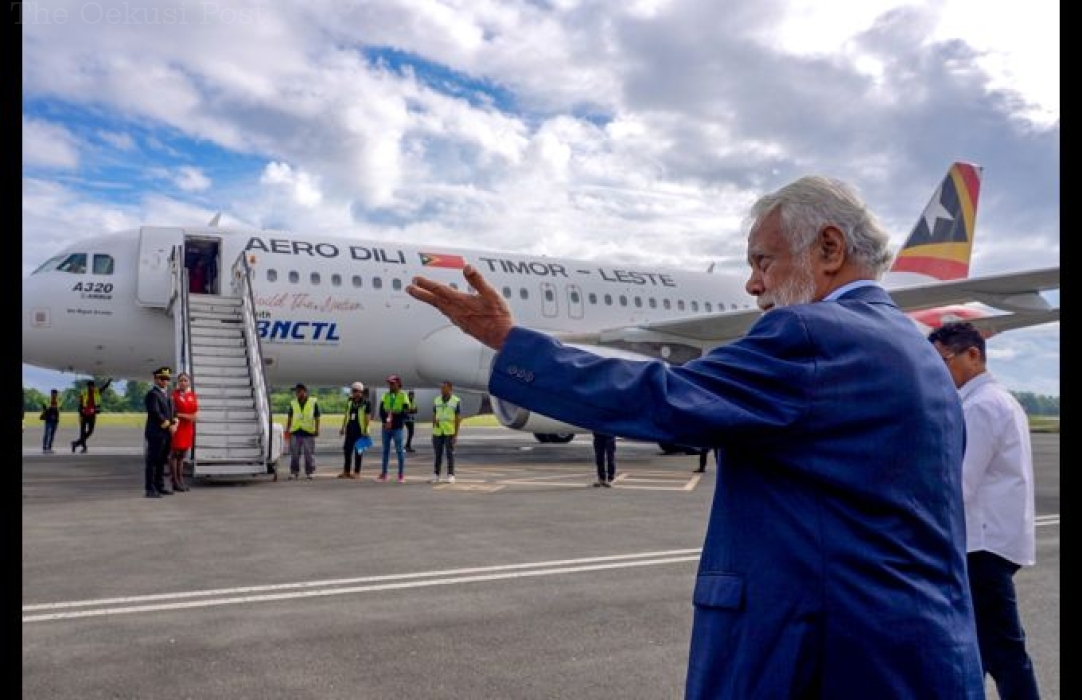
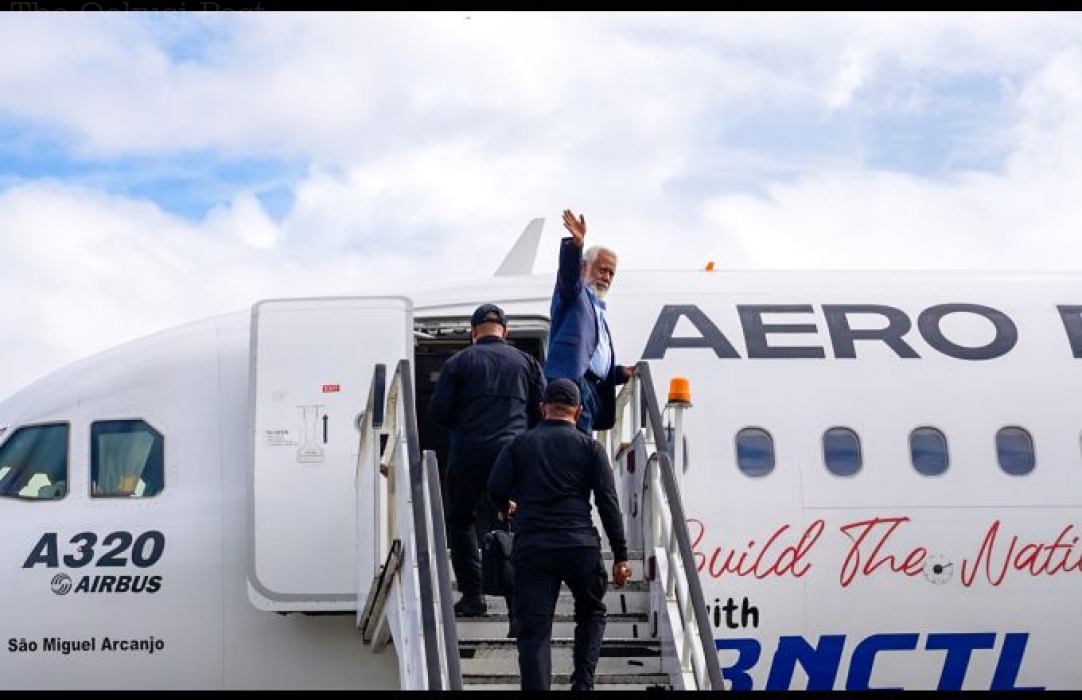
DILI (TOP)— Prime-Minister (PM), Kay Rala Xanana Gusmão flew to Singapore to participate in the third round of negotiations on the Maritime Border between Timor-Leste (TL) and the Republic of Indonesia (RI), Saturday, April 25, 2026 by Aero Dili at 9:00 am.
According to official information from the PM Media section said that the third round of negotiations is a continuation of two rounds of formal negotiations held in 2025: in August in Dili and in December in Yogyakarta, Indonesia.
Timor-Leste's delegation to the negotiations is led by the Executive Director of the Land and Maritime Borders Office and the current Head of the Prime Minister's Office, Elizabeth Exposto.
Timor-Leste and Indonesia enjoy close and lasting relations and serve as a global model for reconciliation and constructive partnership.
As neighboring countries on land and sea that share borders to the north, west and east, the two countries are obliged under the United Nations Convention on the Law of the Sea known as UNCLOS to delimit their overlapping maritime areas in order to clarify the extent of their sovereignty and rights. sovereign.
After the successful conclusion of the mandatory conciliation with Australia under UNCLOS and the signing of the 2018 Treaty between Timor-Leste and Australia, establishing their maritime border in the Timor Sea, Timor-Leste paid attention to the delimitation of the maritime border with Indonesia.
The 2018 Maritime Border Treaty between Timor-Leste and Australia expressly states that there is no prejudice to the negotiation and delimitation of the maritime border between Timor-Leste and Indonesia.
The maritime border is very important to Timor-Leste because completing a permanent maritime border is a national priority for Timor-Leste.
This is the final step to establish Timor-Leste's full sovereignty and sovereign rights as an independent State.
For the people of Timor-Leste, securing the country's right to its maritime areas is a continuation of their long struggle for self-determination, sovereignty and independence.
A clear and agreed maritime border provides legal certainty and allows Timor-Leste to responsibly explore, manage, protect and develop its marine and underwater resources, including energy and fisheries.
This will support sustainable economic development, encourage investment and business confidence and strengthen long-term national planning.
Revenues from these resources contribute to Timor-Leste’s sovereign wealth fund, which is dedicated to supporting intergenerational equity and building a prosperous, inclusive and sustainable future for the people of Timor-Leste.
Indonesia is the largest archipelagic state in the world consisting of more than 1,000 islands. The country shares a maritime border with ten states.
Indonesia has currently agreed or partially agreed maritime borders with Malaysia, Australia, Thailand, Singapore, India, Papua New Guinea, Vietnam and the Philippines.
Of these countries, Timor-Leste and Palau are the only two countries with which Indonesia has not reached an agreement on maritime borders; but Indonesia has begun discussions with the two countries.
The point of the maritime border negotiation situation with Indonesia is that the leaders of Timor-Leste and Indonesia agreed in August 2015 to renew and expand bilateral discussions to cover land and maritime borders.
Timor-Leste and Indonesia began discussions on the permanent delimitation of the maritime border in September 2015.
During the initial phase of the consultations, the two countries jointly developed guiding principles, technical methodologies and a work plan for the negotiations.
Both states committed to negotiate permanent maritime boundaries in accordance with international law, particularly UNCLOS.
Preliminary technical meetings between Timor-Leste and Indonesia were held in late 2018 in Bali and in early 2019 in Singapore and Bali. These meetings established an important basis for future negotiations.
Since the end of 2021, Timor-Leste and Indonesia have continued discussions through diplomatic channels to advance the peaceful delimitation of their maritime borders, in accordance with international law and in the spirit of close neighborly relations.
These efforts have included high-level exchanges and informal meetings aimed at gaining mutual understanding and paving the way for formal and substantive negotiations.
These continued discussions resulted in an important milestone with an agreement to begin formal maritime border negotiations in 2024.
The areas subject to delimitation are Timor-Leste's four unresolved maritime segments with Indonesia, as follows:
- On the south coast, in the Timor Sea, it is necessary to negotiate the maritime border to the west and to the east;
- In the North, the Oe-Cusse enclave raises special issues because it is far from Indonesia;
- There are also two sections in the seas from Batugade to Ataúro Island and through the Wetar Strait down to Jaco Island that need to be delimited.