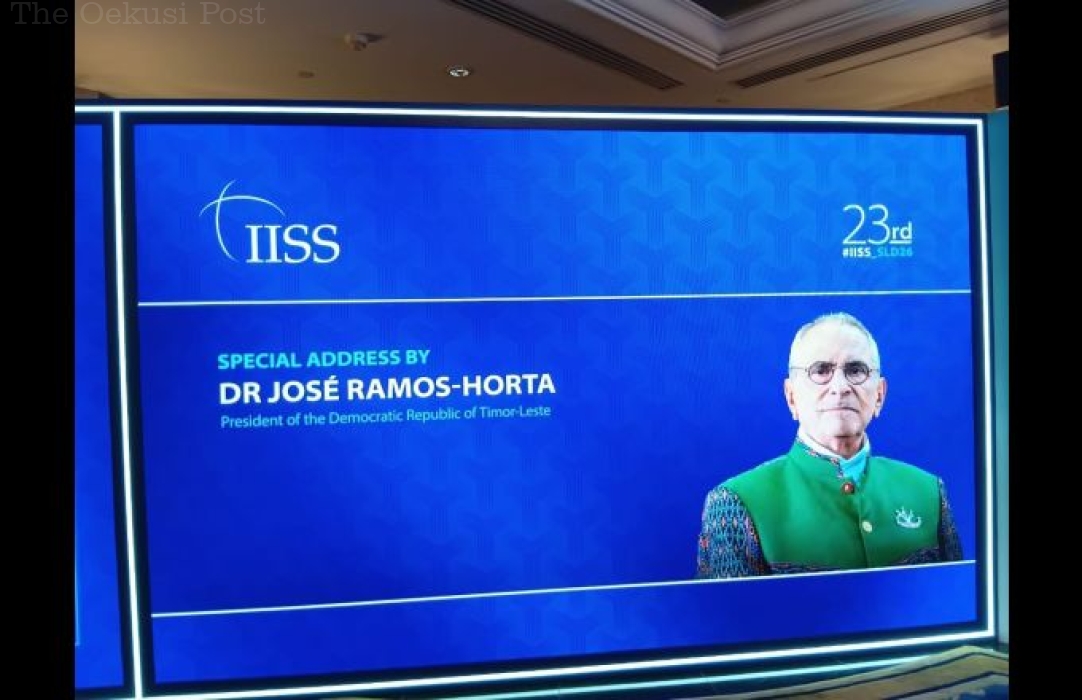
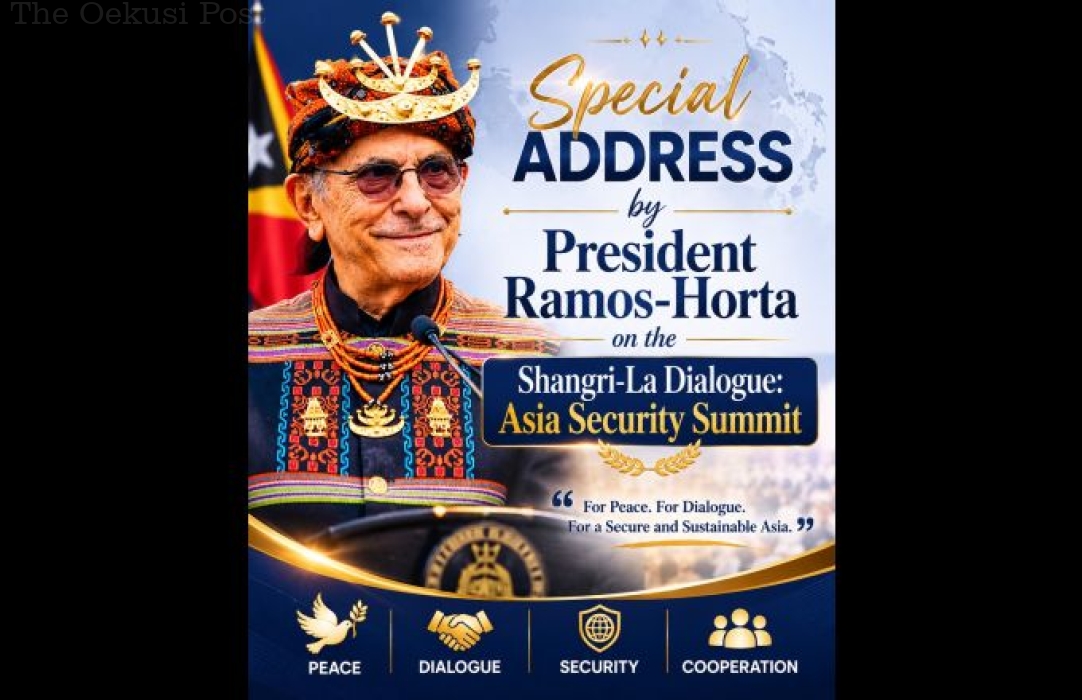
Special Address
by J Ramos-Horta,
President of Timor-Leste
Nobel Peace Laureate (1996)
Singapore, 30th May 2026
Defining the Third Path: Renewing Practical Diplomacy to Address the Root Causes of Global Disharmony
Sir John, Dr Bastian, thank you for the privilege to be part of the Shangri-La Dialogue. More than ever, the Shangri-La Dialogue matters, matters today, at this very hour. It is one of the few places where the languages of security and diplomacy meet side by side, both are needed.
Let me start with few words on what we all know. Our main international security architecture - the United Nations Security Council - is moribund, sclerotic, irrelevant. It is a sad mirror of the state of the world today.
I am not sure that a simple expansion of membership and elimination of the veto power would revive and render it to be an effective and credible guardian of international security.
The newest judicial body, International Criminal Court created with much fanfare in 2002, is being destroyed. But it seemed that the ICC was meant only for alleged African dictators, so it was allowed to issue arrest warrants and conduct trials. Timor-Leste was among the first signatories of the 2002 Treaty of Rome. ICC is facing an existencial threat - all because its Prosecutor tried to honour the proverbial principle Justice is Blind.
We routinely speak of preserving the rules-based order; but rules do not survive because they are printed in charters. They survive because states choose restraint, consistency, chose dialogue to resolve grievances. Rules need institutions and trust. And trust is not created by declarations. It is built through the unflagging pursuit of common interests and the good faith application of rules and norms.
Sustained security cannot come from the barrel of a gun, from coercion and fear. There is more to order, more to security and more to peace. When these failures expose the most vulnerable to further harm, it undermines the laws and institutions we have all created over decades to prevent wars and resolve them when they happen.
Governments have a duty to protect their country sovereingty and territorial integrity, and above all governments have the sacred ultimate responsibility to protect its own people, their physical being and rights to live in freedom and dignity. We are a small country with a turbulent history, but we are always hopeful. We learned through history that hope is an inner strength, it is the one thing we hold on to when we have lost everything else.
Our independence was built through years of patient, practical diplomacy that gradually turned old wounds into new bonds. We never demonised the other side, we did not disrespect their faith. We were set free when Indonesians freed themselves in 1998-1991 and embarked on a promising process of reforms and democracy.
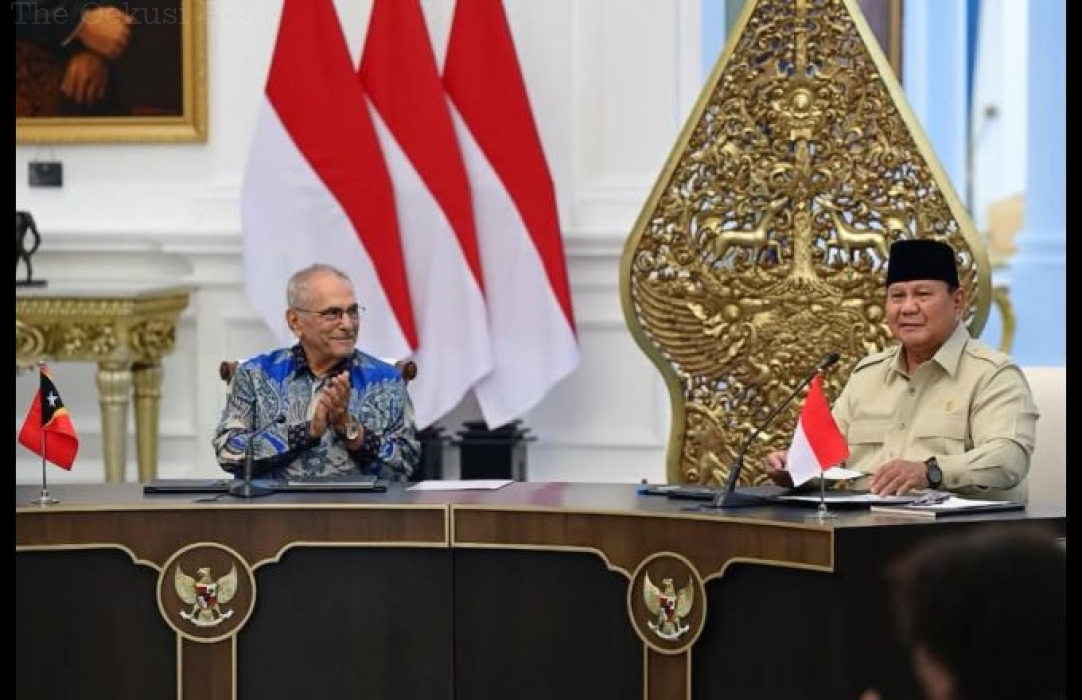
Timor-Leste and Indonesia are a model of reconciliation and partnership. We show that history need not imprison our hearts and minds, history must not imprison nations, wise leadership and dialogue can turn conflict into coexistence, and coexistence into friendship and trust.
ASEAN was not born in a tranquil epoch, it was born from the ashes of the Korean war, the wars in Vietnam, Cambodia and Laos, Maoist insurgencies, colonial scars, Cold War rivalries, ideological madness and confrontation. Its success was not that it eliminated differences. It did something more modest, and perhaps more profound: it planted a Banyan tree, and under its foliage leaders gathered and ploted the end of wars.
Over decades, ASEAN brought together nations that lived and suffered from all of the above. Wise leaders believed that sovereignty and cooperation are not opposites. Through the Treaty of Amity and Cooperation, it affirmed principles that sound simple but were revolutionary when practised: mutual respect, relentless, persistent negotiations leading ton peaceful settlement of disputes, renunciation of the threat or use of force, and effective cooperation. The resulting trust between ASEAN nations has delivered vast mutual benefits. ASEAN’s economy has underpinned by extensive intraregional trade.
ASEAN is not Heaven on Earth. Achieving consensus is frustratingly slow. Diplomacy can disappoint. Disillusionment can produce cynicism. Security challenges persist. The Myanmar civil war is a stain in ASEAN's otherwise impressive catalogue of successes.
Nevertheless, in a world where bridges are being burned faster than they are built, ASEAN provides lessons on how sustainedx dialogue, engagement, can safeguard against conflict and deliver shared benefits. This safeguard can also support strong civilian and military leadership in brokering fair, sustainable, bilateral agreements. It can create the space for imagination, vision and negotiation.
These are the thoughts - of despair and hope - that came to me as I watch the abysmal failure of global leadership resulting in the devastating wars in Ukraine, Gaza, Lebanon, Iran, consequences of which reverberate across the world. Were a similar failure to halt freedom of movement and fragment trust in the South China Sea, the consequences for our world could be even greater.
The South China Sea shouldn’t be a flash point. The Convention on the Law of the Sea (UNCLOS) provides space for dialogue and mediation to settle overlapping claims. This maritime area is the lifeline for all of us, including the non-coastal states. The crisis in the Strait of Hormuz shows us just what is at stake if we do not accelerate the pace of negotiations towards a South China Sea Code of Conduct and enhance existing conflict prevention mechanisms.
Southeast and East Asian Nations, with and without Exclusive Economic Zones, have a chance to come together under the vision of the South China Sea as a Zone of Peace, recalling other longstanding territorial arrangements that have secured access to contested global commons, as in the case of the Antarctic Treaty System or the collaborations that led to the Space Station Intergovernmental Agreement, whose mandate was premised on peaceful purposes.
Will leaders stand up yet taller and think beyond narrow national interests and short term gains? If here I risk words that dreamers use, I invite you to weigh such words with me for a moment. In a Zone of Peace, deterrence surely has its place. Readiness has its place. But the logic does not add up if we mistake short-term security plans for long-term security.
In 2025 global military expenditure reached almost three trillion dollars. At the same time, ODA has fallen to lowest levels ever, and climate adaptation finance for developing countries remains a fraction of what is needed. Consolidating freedom of movement for the future, one of the hallmarks of this Zone of Peace I envision, claimant States do not abandon their respective claims under UNCL0S, all agree to create this Zone of Peace, free of artificial islands and military bases that inevitably add to suspicion, fear, and counter actions. Existing artificial islands must be open, accessible, hosting oceanographic and marine life studies.
Military vessels entering this Zone of Peace would adopt customary markings of Peace, signalling to one another in a language that the parties to the Strait of Hormuz closure could not. We have researched the alternatives to such cooperation all too well. While we are finding more money to prepare for war, we struggle to find money to prevent the conditions that make conflict more likely.
A missile can deter an adversary but it cannot hold back the sea. A tank can defend a border, but it cannot restore a failed harvest. A submarine can patrol an ocean, but it cannot rebuild trust in a society displaced by disaster and conflict. Weapons of war are not fit for all the purposes that we are tempted to set out for them.
I return to my refrain: nothing would be more practical than a sustainable, long-lasting Zone of Peace that keeps movement in the South China Sea open and equitable for coastal and non-coastal states alike who depend on its stability. But the sea also can be a mirror for us to review a range of deep assumptions. When we talk of the ‘blue economy’ for instance, it is not simply one more agenda item to quantify our national resources, but a transformational rethinking that sees ‘narrow’ sovereignty placed among connected oceans and taking part in broader notions of prosperity. It leads us back to notions of resilience that arise from our interdependence.
Kay Rala Xanana Gusmão, our Prime Minister and Special Representative for the Blue Economy in Timor-Leste, led our 9th Constitutional Government in adopting this aim: "to transform our sea — which is central to our identity, economy, and geopolitics — into a source of sustainable development, inclusion, and environmental resilience.” He added that “for Timor-Leste, the Blue Economy is not only a strategy for survival but also for development and climate resilience.”
Indeed, for island and coastal nations like ours, the need for such resilience is not abstract. Climate change is not a distant environmental issue. It is a security crisis. It threatens homes, fisheries, infrastructure, water, food systems and, in some cases, the very territorial integrity of states. I was reminded of this while recently attending the Melanesian Ocean Summit in Papua New Guinea, where leaders from across the Pacific again highlighted that climate change is a direct threat to economic stability, food systems, social cohesion and even state viability itself.
If we fail to invest seriously in resilience and prevention, more countries will be pushed to the brink. More people will be forced to move. More governments will face impossible choices. Instability will not remain neatly within borders. For smaller and middle powers, choosing resilience cannot be an ultimatum between bloc politics and isolation, between nostalgia for
an order that was never perfect and their surrender to a world governed by brute force. For smaller and middle powers, this path begins with a refusal to accept that the future must be organised only around confrontation. We do not have to accept a world divided permanently into rival blocs. We can work with all where interests are shared; speak clearly where principles are threatened; and build coalitions around the practical tasks no country
can solve alone. Coalitions must be built issue by issue: on climate finance, on energy security, on marine health, on food resilience, on disaster preparedness, on digital governance, and on peace mediation.
To put it bluntly, the third path must be both principled and pragmatic. I have known it and travelled it first hand. The emergence of conflict can erode years of progress towards sustainable development. We must therefore pay renewed attention to addressing the conditions that drive conflict and to preserving the mechanisms that prevent it. This means developing a more practical diplomacy for the 21st Century.
ASEAN, and Timor-Leste's, unique story within its constellation, hold key lessons for patient, practical and effective diplomacy. ASEAN’s achievement in this respect is not that it made all countries think alike. It has not erased differences in history, politics, size or strategic outlook. Instead, it has created habits of cooperation despite those differences.
Meeting by meeting, agreement by agreement, project by project, ASEAN has showed that trust can be constructed. It has showed that dialogue can become trade, trade can become interdependence, and interdependence can become a shared interest in peace. This is the kind of diplomacy our world now needs more of. Not diplomacy as hollow ceremony. Not diplomacy as performance. But diplomacy as patient construction. If we are serious about a third path with impact underpinned by practical diplomacy, then we must make it visible in concrete areas. We must treat energy security and climate resilience as core security issues.
A region with more weapons but failing grids, vulnerable coastlines, fragile food systems and unaffordable energy is not secure. It is merely waiting for the next shock. We must ensure that climate and development finance are not treated as optional generosity, available only when budgets are comfortable. For vulnerable countries, resilience is not charity. It is prevention. It is the work that reduces the likelihood of displacement, instability and future conflict.
And we must apply rules consistently. Selectivity corrodes trust. When rules appear to protect some and not others, smaller states begin to wonder whether the language of order is really only the language of power. A rules-based order only survives when countries see that restraint, fairness and peaceful settlement are practised, not only preached.
This is not idealism. It is realism with a longer horizon. Let us therefore leave this Dialogue with a clearer sense of what peace requires. It requires defence, yes, but it also requires prevention. It requires national strength, but also practical cooperation across borders through patient diplomacy. It requires rules, but also the trust that gives rules life. Practical, patient diplomacy, can build this trust.
In 2026, let us be clear-eyed about danger, but not captured by it. Let us be committed to maintaining security, but devoted to building the conditions for a Zone of Peace in the South China Sea for all of Southeast Asia, for all of Asia, for the world. May the God of all Humanity shower leaders with wisdom and compassion.