


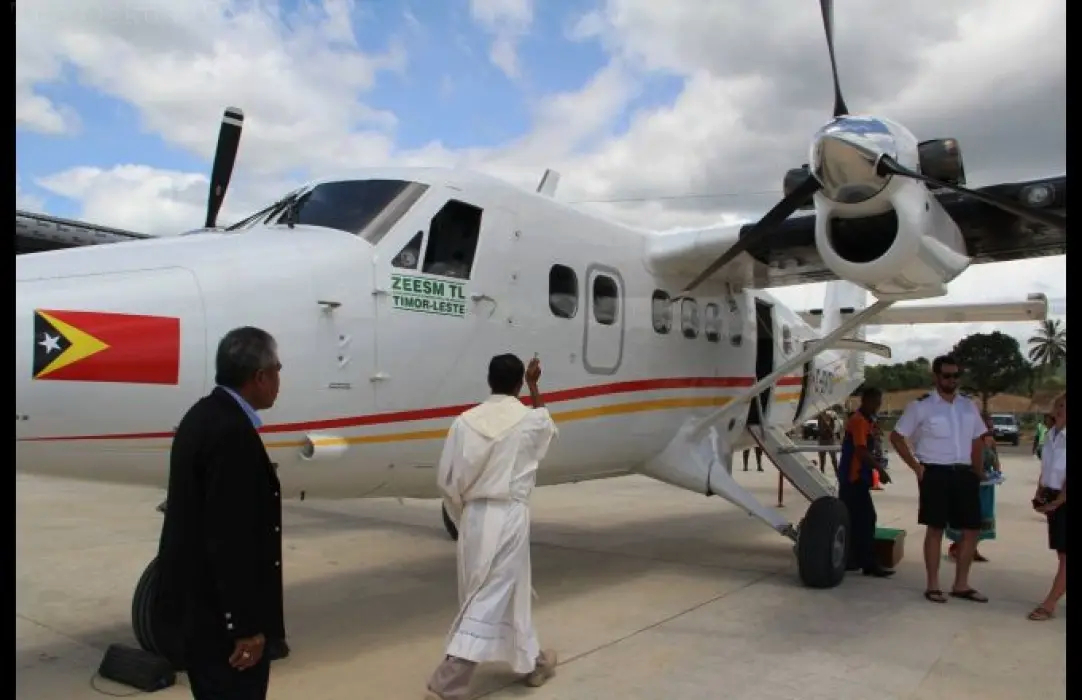
Audit Report No. 1/2018 shows that the process is “lack of transparency”. Mari Alkatiri and Arsénio Paixão Bano replied that the new aircraft and purchase is urgent. Now the plane is parked and under investigation by CAC and the Public Prosecutor's Office.
AMBENO (TOP) - The Chamber of Accounts in the Court of Appeal concluded that the Oe-Cusse Ambeno Special Administrative Region Authority (RAEOA) did not show clearly how it chose aircraft and suppliers when purchasing a DHC-6 Series 400 Twin Otter aircraft worth USD 7,244,769 in 2015. The process was conducted in 2015. by direct fit, and no other quotes were requested.
This conclusion is contained in Audit Report No. 1/2018 (Vol. I), financial audit for RAEOA and ZEESM for 2014 and 2015 (Process n.o 2/2016/AUDIT-S/CC), section 2.8.6.9, page 2.8.6.9, page 19 to 2017. procurement is a process that is “characterized by a lack of transparency”.
Mari Alkatiri, President of the RAEOA Authority at the time, and Arsénio Paixão Bano responded in Vol. II of this report, through a response from the Office of the President of the Authority. They said the preliminary report contained “omissions and misinterpretations” of facts. They maintained that there was no alternative aircraft, the aircraft was new, the purchase was urgent, and the price paid was within market value.
But the case did not end with the audit. The ZEESM plane is now parked and has been taped by the police due to the investigation process. On November 9, 2026, the current President of the RAEOA Authority, Régio da Cruz Salu, informed that the RAEOA has secured the original document of the bill of sale of the aircraft. But he also said the plane could not yet return to operation. The Minister of Transport and Communications, Miguel Marques Gonçalves “Manetelu”, confirmed that the plane will remain parked while the investigation is not completed.
Contract: $7.2 million per aircraft
According to the report, the President of the Authority signed a contract on August 12, 2015 to purchase a Viking DHC6-400 aircraft, registered in Canada with the number C-GVTU and manufacturer serial number 906. The supplier is the company DHC6 Twin Six LLC, and the contract price is USD 7,76,244. The price includes optional equipment worth USD 494,769.
The additional cost to fly to Dili is USD 80,000. Then withdraw USD 35,368 for the Additional Corrosion Protection option. Thus, the total cost of the aircraft is USD 7,289,401.
Direct fit, no quote
The Chamber of Accounts said the purchase of aircraft was done through direct adjustment, and the Authority received questions about how the process of selecting aircraft and vendors worked. The President of the Authority, Mari Alkatiri, replied that, in order for the aircraft to operate in November 2015, RAEOA resorted to specialized and pro bono advice from advisor Francis, who has died. Through direct contact with the supplier, they purchased the DHC-6 Series 400 Twin Otter MSN 906 aircraft “in good time”. According to him, the aircraft initially cost more than USD 1,000,000 compared to the actual cost.
The Chamber of Accounts said the information did not clarify how the aircraft and supplier were selected. The report also shows inconsistencies in the RAEOA document itself.
Two deliberations a day. On 24 July 2015, the Authority decided to authorize the purchase of aircraft and appointed the President to lead the process. Resolution n.o 2 states that it is necessary to “obtain quotations”, to know the best quality-cost relationship and opportunity. On the same day, Resolution No. 3 awarded the purchase to DHC6 Twin Six LLC.
The process had started before the deliberation. On 13 May 2015, the President of RAEOA, Mari Alkatiri, sent a letter to the Minister of Public Works, Transport and Communications. The letter mentioned the need to purchase “Twin Otter Series 400 aircraft with 19 seats (USD 8,000,000)”. In the annex, there is a minute Letter of Interest dated 8 May 2015, to celebrate between the company Utility Air (Australia) and RAEOA. The proposals were discussed at the meeting of the Board of Directors of the Infrastructure Fund (CAFI) on 9 June 2015. The body said that a decision on the purchase will be taken in due course.
Therefore, when the Authority decided on 24 July to approve the purchase and mandate the President to conduct the procurement process, the process has already begun and has been submitted to CAFI assessment.
The Chamber of Accounts requested the quotations requested by the Authority and justification for this “incongruity”. Alkatiri’s response was limited to sending back the clarification he had given. The Chamber concluded that no further quotation was requested, although Resolution n.o 2 itself stated that this was necessary. He also said that it did not clarify why specific aircraft types and suppliers were chosen, other aircraft types and suppliers were not selected.
The Chamber refers to article 7 n.o 2 of the Legal Regime for Procurement (LJA), on the principle of transparency, which states that the choice of proposal must always be justified in writing.
In contradiction, Alkatiri and Bano present a developed explanation on pages 64 to 66 Vol. II. The chamber said the explanation did not clarify all the questions. He noted that the explanations were submitted about two-and-a-half years after the purchase of the aircraft, and no evidence of a contemporaneous document justifying that choice or the alternatives considered was found.
Absent a feasibility study, the aircraft operates an hour and a half per day
To assess the economy, efficiency and effectiveness of public expenditure, the Chamber of Accounts asked whether RAEOA had conducted any study on the feasibility of air links. Alkatiri replied that studies indicate, to be sustainable, the plane needs to fly six hours per day, with an average of 12 passengers per flight, through flights to other municipalities and Ataúro.
The camera shows that during 2015 and 2016 routes were limited to Oe-Cusse – Díli – Oe-Cusse, once a day, six days a week. Thus, the plane operated only about an hour and a half, far from the six hours that Alkatiri himself indicated. In the absence of any evidence of the study, the Chamber concluded that the decision to purchase the aircraft was not based on a prior study of economic feasibility.
“Urgency”: Ataúro, aerodromes and the 500th anniversary
Resolution n.o 2 states that there is an “urgent need” to purchase passenger aircraft to ensure the connection Pante Makassar – Dili – Ataúro and other destinations. The Chamber of Accounts questions this with the following arguments.
- Alkatiri himself said in his clarification (July 2016, about a year after the purchase) that he requested the rehabilitation of another airfield so that the plane could operate. With the closure of Suai airport, there is no other airport or airport in Timor-Leste that can receive RAEOA flights. The aircraft is a STOL type, but it requires a compact ground runway with a minimum length of five hundred meters.
- Regarding Ataúro, on 24 December 2015 a survey of the airport was conducted, with the participation of pilots and co-pilots of RAEOA aircraft. Alkatiri himself said that the risk of the operation "is, and will be, high"
- Only flight Oe-Cusse – Díli remains, especially for the 500th Anniversary. The Chamber considers justifying the purchase of a plane worth nearly USD 7.2 million with a commemoration that lasts only two days as insufficient justification, because it can rent a plane or take guests by sea.
- Before RAEOA purchased the aircraft, there was already an air connection Oe-Cusse – Dili for passengers, which was ensured by private companies and institutions. MKM Aviation Service (helicopter) and MAF International, RAEOA resorted to a minimum of 21 times for air transportation (one-way trip) between March to October 2015. The Chamber said MKM and MAF “can easily” be used to transport guests to the commemoration.
- The Chamber also noted the contradiction in the contradictory. Alkatiri and Bano said the purchase of the plane was planned, but later said the celebrations were an "urgent fact" that justified the purchase at this time. The report also said the purchase of aircraft was not in the 2015 budget.
Is it a “new” plane?
The Chamber of Accounts said the price of USD 7,244,769 is the same as the price of a DHC-6 Twin Otter aircraft in the new state. For 2017, the indicative price for the same aircraft is USD 6,500,000. The report presents data that, according to the Chamber, show that the aircraft is not very new.
- Letter 13 May 2015 said the aircraft to be purchased is being produced and can be delivered in June / July. Resolution n.o 3 (24 July) says the aircraft is in an “advanced stage of production”. The Chamber said it did not know whether the letter and the resolution referred to the same aircraft.
- According to the Canadian Civil Aircraft Register, the C-GVTU aircraft (MSN 906) was produced in 2014, and Viking Air Limited first registered it on 29 May 2014. When the contract was signed in August 2015, it had been more than a year since its production.
- On the Internet there are photos and information about the flight of the aircraft in August 2014. On December 29, 2014, the company CAVU Aviation Finance LLC published an advertisement for sale or lease of the aircraft, with photos of the completed aircraft.
- The authority, led by Alkatiri, “prefers not to answer” when asked about the incongruity between the Deliberation and the date of registration of the aircraft.
In contradiction, Alkatiri and Bano said the plane was new, as also stated in the sales announcement, and the plane was with the manufacturer. They presented a statement from the seller that when the plane arrived in Dili on 2 November 2015, it had a total of 62 flight hours, mostly relative to flights from Canada to Timor-Leste.
Optional equipment: USD 184,861 still sealed in containers
The contract price includes optional equipment worth USD 494,769, as shown in Annex F of the contract and Table 19 of the report.
|
Equipment |
Value (USD) |
|
HF Radio (fully installed) |
101.668 |
|
Flight Data Recorder (FDR) |
132.632 |
|
Cabin emergency lighting system |
15.240 |
|
Executive/VIP Room (4 VIP seats) |
153,587 |
|
Stretcher Rack (there are two) |
31.274 |
|
External logo ink |
25,000 |
|
Additional Corrosion Protection |
35.368 |
|
Total |
494,769 |
The Chamber of Accounts shows that VIP seats and that they are not installed on the plane. Alkatiri justified that the equipment is “adaptable, easy to assemble and remove”, can be used when needed, and is needed for visiting VVIP entities and security reasons. The Chamber said this, "with respect", does not correspond to reality. The assembly represents a significant alteration to the interior of the aircraft and involves passenger safety. The contract itself mentions the equipment as “options to be installed pre-closing”, and the price includes installation. The Chamber also said that, according to the maintenance and operation contract, there are no engineers living in Timor-Leste.
In contradiction, Alkatiri and Bano submitted photos of VIP chairs and them, which they said were stored at Dili Airport. The Chamber of Accounts conducted an inspection on 17 May 2018. The report notes that the text of this point has changed compared to the preliminary report, because Alkatiri and Bano have shown effective supply of the equipment. From this inspection, the Chamber pointed out the following facts.
- This equipment (four VIP chairs, one VIP table and two) cost RAEOA total USD 184,861 and stored in a container at Dili Airport.
- Three of the four volumes transporting the VIP seats, which cost USD 153,587 to the public coffers, are still closed without being used once, or without opening their packaging.
- The chamber did not question is their usefulness, but questioned their price of USD 31,274.
Operating cost: deficit USD 3,881 per day
The aircraft operation is under contract with a third-party company. Kenn Borek Air manages and operates at a cost of USD 137,000 per month (USD 1,644,000 per year), excluding maintenance expenses. STAT does ground handling and marketing (selling tickets) with a 10% commission. Stars (TL) supplied fuel at USD 1.27 per liter in November 2015.
The cost of RAEOA with these contracts in November and December 2015 rose to a minimum of USD 763,785. The cost includes a security deposit of USD 200,000 and a down payment for a maintenance fee of USD 220,000. Excluding the deposit, the total cost would be USD 563,785. Operating revenue in the two months was USD 134,428.
The chamber pointed out that the occupancy rate was high in this period due to more than one flight per day before and after the 500 Years Commemoration. An average of 13 passengers per flight out of 158 flights, compared to 19 seats. This did not happen in 2016: in March 2016, the average was only 10 passengers, some more than half the available seats.
The Chamber estimates the daily cost of the aircraft, which flies two flights a day, six days a week.
|
Description |
USD per day of operation |
|
Total expenditure |
6,465 |
|
Total revenue (USD 68 tickets, 100% occupancy) |
2,584 |
|
Estimated daily deficit |
-3.881 |
This estimate considers 25 days of operation per month and does not account for maintenance expenses. The Chamber concluded that the deficit would occur even at 100% occupancy. He also said that increasing the price of tickets could remove demand, with the exception of passenger employees RAEOA or central public administration, whose tickets are paid with public money. The Chamber said these factors should be considered before buying an aircraft, but did not happen because there were no previous studies.
Mari Alkatiri and Arsénio Paixão Bano's answer
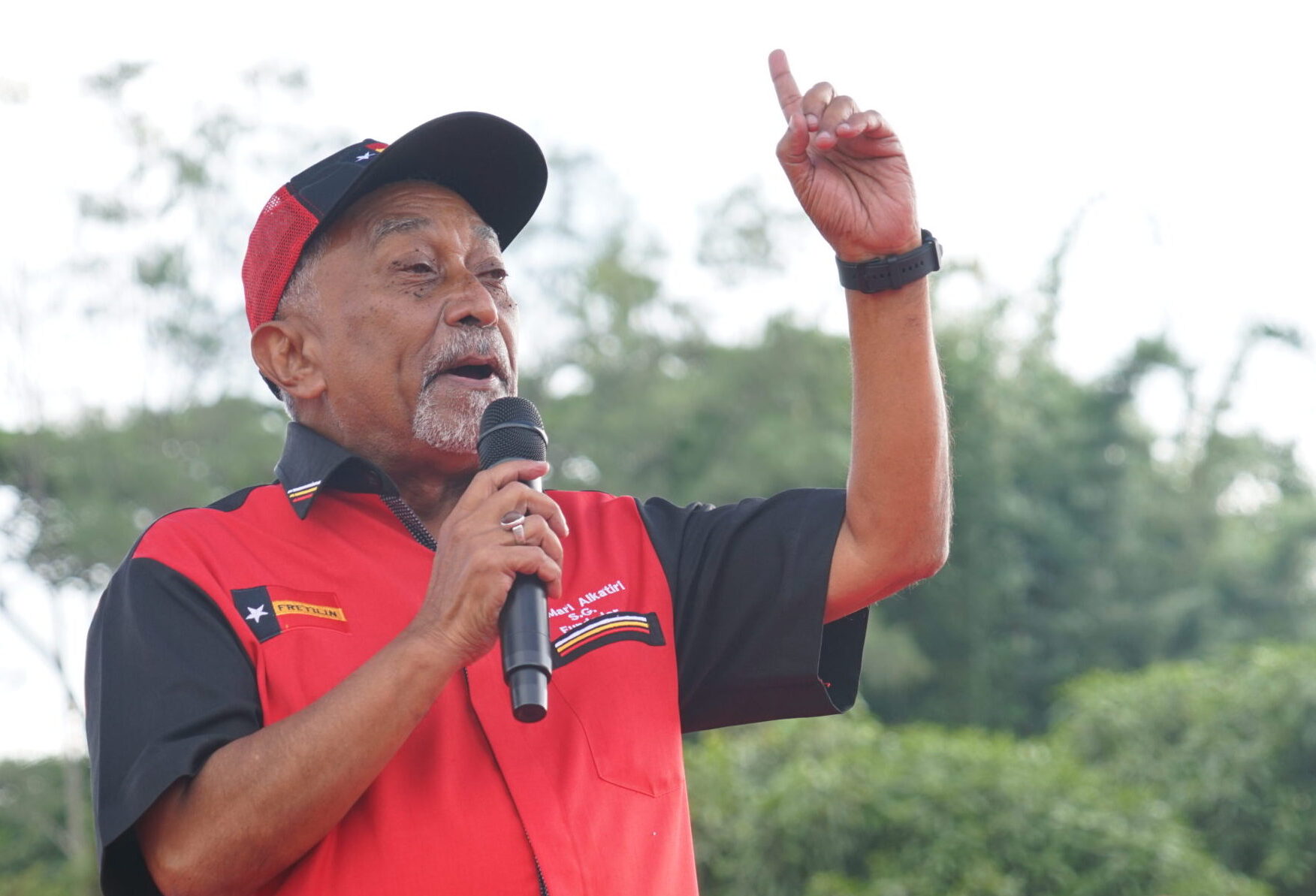
In Vol. II (paragraphs 549 to 703), Alkatiri and Bano respond to the conclusions in five points.
Direct fit and plane brush. Alkatiri and Bano said there was no alternative aircraft. According to them, choosing an aircraft also means choosing a manufacturer. They wanted aircraft with a capacity of less than 20 seats, with STOL capability, and easy maintenance. They give examples of aircraft that have ceased production: Beechcraft 1900 (2002), Britten-Norman Trislander (1980), Embraer EMB110 (1991), Metroliner (1984) and Dornier 328 (2000). They say Viking has a “market monopoly” in the segment. The alternative is aircraft aged 16 years or older, which require a thorough maintenance assessment, and there is no operator in Timor-Leste or civil aviation authority with the competence to manage this. They also said that the MSN 906 aircraft was purchased because it was available, and ordering before manufacturing would wait more than a year.
Lack of profitability. Alkatiri and Bano said the Region does not put profitability as a decisive factor, and it is not the Region's attribution to operate aircraft profitably. The objective is to establish an air link to the Oé-Cusse enclave, to create investment conditions and reduce the effect of “insularity”.
They say the cost is high because the plane is operated by a foreign operator, and part of the management commission is a “royalty” for using a Canadian air operator certificate. Registration in Timor-Leste is not possible because there is no aircraft registration, technical maintenance rules and air operator certification rules. They blame the central government and ANATL, E.P., which is responsible for the management of the airport and aerodrome. According to them, the required maintenance is simple: an employee on the runway during the flight, balancing, watering the runway and removing rocks.
Urgency. Alkatiri and Bano said the House confused two issues. According to them, the 500th Anniversary is not the reason for buying the plane, but the "urgent fact" that justifies the purchase at this time. They argued that the House itself implicitly acknowledged urgency when it suggested aircraft leasing, as the lease also required an urgent public tender.
Cost. Alkatiri and Bano said the reference price of USD 6,500,000 is unfounded and probably comes from guides such as aircraft bluebook. The final price of USD 7,244,769 is a 10% variation. If the sum of USD 494,769 from Annex F is USD 6.5 million, the result is USD 6,994,769, a difference of only USD 250,000, excluding administrative, escrow and registration expenses. They said the information that the aircraft was “used” was false:
- May 2014 registration was done in the name of the manufacturer, as the contract (clause 3.1.1) obligated the manufacturer to deliver the aircraft with registration and airworthiness certificate.
- August 2014 photo corresponds to a test flight for certification, according to Canadian civil aviation standards (CARS 507.04).
- December 2014 photo shows aircraft registration with serial number 955, not 906. The ad itself says “NEW Twin Otter 400 available immediately at factory”, with 0 flight hours.
- Timeline: contract 12 August 2015; registered under the name “Planes & Parts Limited” on 5 August 2015; changed registration to Kenn Borek Air Ltd. on November 17, 2015.
- The manufacturer itself said it delivered 27 Twin Otter 400s in 2014. They said sales of the aircraft in the year following manufacture were normal.
- The seller's letter confirms the aircraft arrived in Dili on 2 November 2015 with 62 hours, mainly from a delivery flight from Canada.
Optional equipment. Alkatiri and Bano falsely said that the equipment does not exist: it is in the hands of the Region and can be inspected at Dili Airport. The preliminary report concluded that the payment was illegal because there was no consideration, but they said the premise was false. They also said that the aircraft cabin has many approved configurations, and engineers based in Timor-Leste can make the change, "including on the day itself" They also removed a message from the operator's maintenance technician, Scott Darroch, that changing configurations on the same day would limit the number of flights that could be made.
After audit: plane stopped, investigation taken to CAC
The plane was parked pending investigation. Before January 2025, the RAEOA Authority decided to stop the movement of ZEESM aircraft and submit it to the investigation process, because it identified "some irregularities", according to Agência Tatoli. The President of the RAEOA Authority at that time, Rogério Tiago Lobato, together with the Minister of Manetelu and Aero Dili, informed that Aero Dili will operate the route Díli – Oe-Cusse and back during the ZEESM plane in the investigation.
CAC receives delegation. On January 14, 2025, Commissioner of the Anti-Corruption Commission (CAC), Rui Pereira dos Santos, said CAC received a delegation from the Public Prosecution (MP) to investigate the ZEESM plane case. According to him, at that time CAC had started the investigation process and was conducting the document collection phase. He explained that these documents are needed to know whether a crime has occurred.
Many witnesses, difficult because the plane was bought in Canada. In August 2025, the CAC Commissioner said in his file of Oe-Cusse about 400 cases.
He said MP will divide the cases, and ZEESM plane, Ró Haksolok and house and land Fulolo will be treated separately. He said CAC has heard many witnesses in the plane case and has collected documents. But he said CAC faced difficulties, because the plane was purchased in Canada and the Canadian Embassy is not in Timor-Leste. CAC will need to coordinate with the Ministry of Foreign Affairs and Cooperation to contact the Canadian Embassy in Jakarta, but has not yet reached this stage.
International audit. In May 2024, Prime Minister Xanana Gusmão decided to conduct an international audit of the Haksolok ship and the ZEESM aircraft, according to Tatoli. According to RTTL, the audit was handed over to a company from Portugal to analyze the management and expenditure of ZEESM aircraft (together with Ró Haksolok).
Record and document problems. On 9 October 2025, Minister Manetelu said ZEESM aircraft can not continue operation until it has official documents and is not registered with the Civil Aviation Authority of Timor-Leste (AACTL). He said the aircraft’s condition was also “deteriorating,” and that the aircraft was still using the Canadian registry (CofR).
So he can only fly in Timor-Leste and can not make commercial flights to other countries. To expand flights, aircraft must be registered with AACTL to obtain 4W registration and certificate of airworthiness (CofA). The minister also said they must prepare legal documents with the Canadian aviation authority and AACTL before obtaining flight permits.
This shows the context relevant to Alkatiri and Bano's response in 2018. At that time, they said aircraft registration in Timor-Leste was not possible because there was no aircraft registration and national certification rules. In October 2025, the aircraft will not be registered with AACTL.
Bill of sale in RAEOA's hands, plane can not operate
On November 9, 2026, the President of the RAEOA Authority, Régio da Cruz Salu, told Radio Rafa in the National Parliament that the original document bill of sale of ZEESM aircraft is now in the hands of the RAEOA Authority. According to him, the legal party that verified the issue has also seized the document. Then, he gave the following information.
- The process of transferring administrative responsibility from foreign partners to RAEOA continues. The previous contract with the partner will be terminated in November or the following month. Rafa did not name the partner. The 2018 audit report identified Kenn Borek Air as the contracted operator.
- The RAEOA Nave Air Team will travel to Canada to receive all documents related to the aircraft, because the foreign partner is ready to hand over responsibility.
- The aircraft has not been able to return to operation due to the investigation process. RAEOA must respect this process until the end, to avoid actions that could harm the investigation.
- In order for aircraft to operate again, an institutional structure is needed that can manage operations, including airline licenses and responsibilities. Therefore, RAEOA conducted a feasibility study to establish its own airline.
- Régio Salu recognizes that the aircraft is of great importance for connectivity and reducing the isolation of Oe-Cusse, and RAEOA wants the aircraft to return to operation quickly, but with legal, administrative and technical procedures.
In the same place, Minister Manetelu confirmed that the ZEESM plane stopped and was pulled away by police tape because of the investigation process. He said he did not want to talk about details, but said that when people pull police tape around an object or asset, it means there is a problem.
Aircraft cost 2016 to 2024: about $29.5 million
On November 9, 2026, RAEOA will provide Radio Rafa with a list of ZEESM aircraft expenditures for 2016 to 2024. This data is provided by RAEOA itself.
|
Year |
Operations (USD) |
Ground handling (USD) |
Fuel (USD) |
Parts USD |
|
2016 |
1.638.930,00 |
96.000,00 |
190.000,00 |
173.000,00 |
|
2017 |
1.638.930,00 |
117.600,00 |
202.000,00 |
160.000,75 |
|
2018 |
1.704.000,00 |
114.000,00 |
203.000,58 |
200.545,00 |
|
2019 |
1.875.455,00 |
103.200,00 |
201.050,80 |
195.600,00 |
|
2020 |
1.776.000,00 |
108.000,00 |
203.904,08 |
245.500,50 |
|
2021 |
1.776.000,00 |
122.400,00 |
2.039.004,08 |
260.000,50 |
|
2022 |
2.082.246,54 |
164.770,43 |
286.446,89 |
275.650,00 |
|
2023 |
2.337.879,35 |
82.237,35 |
204.220,51 |
300.000,00 |
|
2024 |
996.000,00 |
7.508,25 |
Not given |
Not given |
This number is as published; it is ten times more fuel than any other year.
According to the RAEOA summary, the total cost is as follows:
- Operation: USD 15,825,440.89
- Ground handling: USD 915.716,03
- Fuel: USD 3,529,625.94
- Cost: USD 1,536,646.75
- Operation and maintenance cost: USD 21,807,430.61
- Aircraft price: USD 7,655,210,00
- Total: USD 29,462,640.61
Fixed operating costs per year show a pattern that is close to the cost indicated by the Chamber of Accounts. The chamber said the contract with Kenn Borek Air is worth USD 1,644,000 per year. RAEOA operating expenditure in 2016 and 2017 is USD 1,638,930. The expenditure rises to USD 2,337,879.35 in 2023.
Alkatiri and Bano's response in 2018 provided a technical explanation and established responsibility for the central government and ANATL, E.P. The chamber said the explanation was presented two and a half years after the purchase of the aircraft. Now, the investigation of CAC and MP continues and there is no public result.